

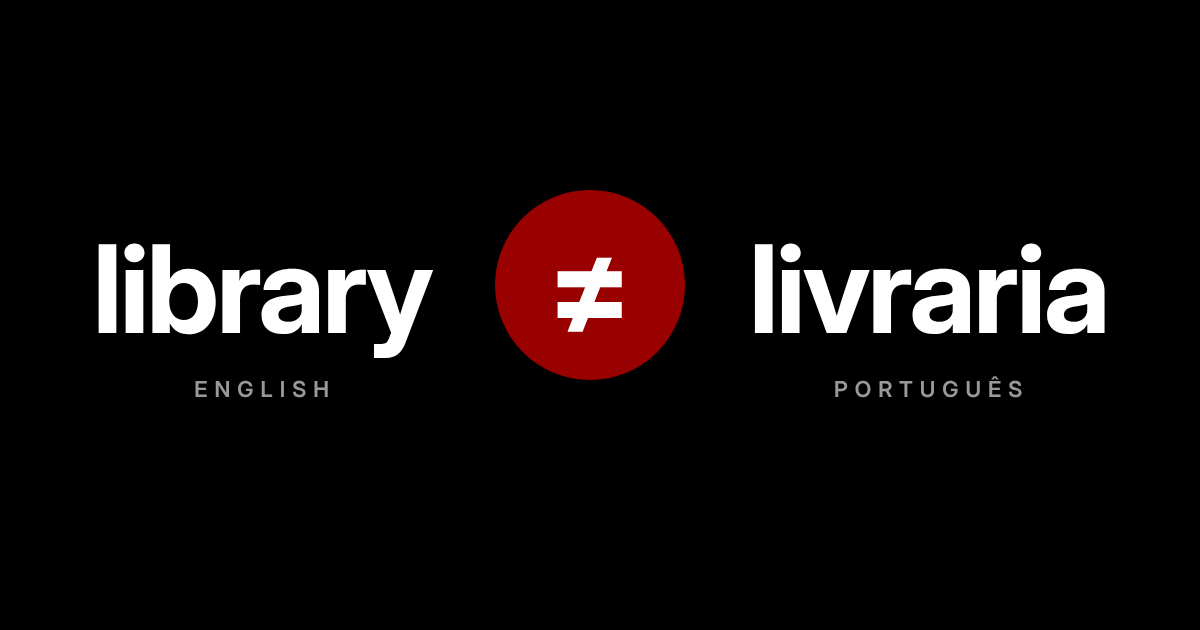
False friends are words that look almost identical in two languages but mean different things. They catch out even fluent speakers, precisely because the word “sounds right”: the brain sees actually, thinks "atualmente" and carries on without a flicker of suspicion. They work in both directions, tripping up Portuguese speakers writing in English and English speakers reading Portuguese. Many of these pairs share the same Latin origin, but the meaning went its own way in each language. Here are the ones I most often spot in clients’ texts, and a few tricks for avoiding them.
The four that catch people out most
Actually does not mean atualmente. Actually means “in fact” or “in reality” and is used to correct something or add emphasis. The Portuguese atualmente means currently or at the moment.
- Sounds wrong: Actually I live in Lisbon. (the speaker means they live in Lisbon right now)
- Better: I currently live in Lisbon.
Eventually does not mean eventualmente. Eventually means “in the end” or “over time”, and suggests that something does happen, sooner or later. The Portuguese eventualmente means possibly or if necessary.
- Sounds wrong: We will eventually send you a discount. (it promises the discount will arrive; it just does not say when)
- Better: We may send you a discount.
Pretend does not mean pretender. Pretend means to act as if something is true when it is not. The Portuguese pretender means intends to or plans to do it.
- Sounds wrong: I pretend to open my own studio. (it says you are faking the opening of a studio)
- Better: I intend to open my own studio.
Assist does not mean assistir. Assist . Assist means “to help”. The Portuguese assistir is what you do when you watch a film or attend a meeting, and in English you watch a film and attend a meeting.
- Sounds wrong: I assisted the meeting yesterday. (it sounds as if you helped the meeting)
- Better: I attended the meeting yesterday.
Ten more to keep an eye on
These come up less in conversation, but a lot in writing. Start from the Portuguese word: the “Looks like” column shows the English word it resembles, and “Actually means” gives its real meaning in English.
| Portuguese word | Looks like | Actual translation |
|---|---|---|
| colégio | college (i.e. a university or higher education institution; in the UK, also a school for those aged 16 and over) | school, private school |
| esquisito | exquisite (meaning refined, delicate) | strange, odd |
| êxito | exit (meaning, for example, the door through which you might leave a building or large vehicle) | success |
| fábrica | fabric (meaning textile) | factory |
| leitura | lecture (meaning a lecture, a presentation) | reading |
| livraria | library (meanig collection of books, a reading room) | bookshop (United Kingdom) bookstore (USA) |
| parentes | parents (meaning progenitors) | relatives |
| resumir | resume (meaning to continue, to restart) | summarise |
| sensível | sensible (meaning reasonable, wise) | sensitive |
| suportar | support (meaning to help, to advocate) | bear, put up with |
Where these mistakes cost you
In conversation, a false friend earns you, at worst, a smile. In published text it gives an impression of carelessness, and it is worse still when it changes what you meant to say. These are the places I see them most:
- Websites and landing pages: “Actually, we offer…” opening a services page, or “We eventually answer within 24 hours” (readers take it to mean that the reply arrives in the end, not that it might arrive).
- CVs and cover letters: “I pretend to develop my skills”, which, in English, means you are faking the development of your skills.
- Professional emails: “I assisted the webinar”, or “We are sensible to your request”, when sensitive towas meant or, better still, “We understand your request”.
- Technical and legal documents: here the risk is not one of image but of meaning. A Portuguese reader taking “compromise” to mean compromisso (a commitment) instead of a mutual concession can change what a contract says.
It is one of the reasons a bilingual website should not be translated word for word, and it is in the review, by someone fluent in the target language, that these slips get caught.
How to avoid the trap
You cannot memorise every false friend, but you can build habits that catch nearly all of them:
- 1. Be suspicious of similar-looking words. The more an English word resembles a Portuguese one, the more it is worth checking. The feeling of “this is obvious” is the alarm bell.
- Check a monolingual dictionary. Cambridge, Oxford or Collins give you the definition and example sentences, and it is in the examples that you see how a word is really used.
- Search for the sentence in quotation marks. If your construction does not appear in texts by native speakers, it is very likely wrong.
- Keep your own list. Every false friend that catches you out goes on a personal list. Before long, that list is your best tool.
- Ask for a proofreading. For texts that will be published or sent to clients, the eyes of a native speaker or a professional translator catch what your own reading lets through.
And if you think it is only a matter of vocabulary, remember that meaning depends on context, and context is what a hurried reading misses. So, even with good tools, the final word should be human.